
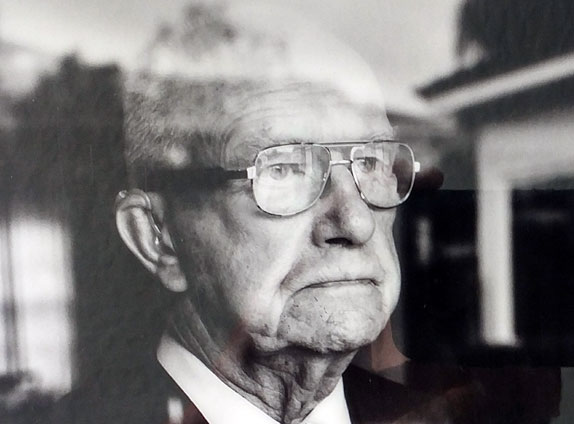
Buckminster Fuller, 1982 – Photo by John Gerstner
I came across a statement I wrote in 1983 as part of a Gannett Fellowship application during my MFA at Iowa.
A few months earlier, I had interviewed Buckminster Fuller. Reading this now, his influence on global thinking is hard to miss. So is something else. A kind of certainty I don’t quite have anymore.
Here’s a fragment:
“We are at a very critical stage in the history of mankind… We now have the resources and technology to raise the quality of life for all the world’s inhabitants to an undreamed-of level… The critical responsibility of consciousness-raising must be largely shouldered by communicators such as myself.”
There’s a part of me that cringes reading that. The scale of it. The confidence. The assumption that I had any idea what I was talking about.
But there’s another part that recognizes it immediately.
The language feels inflated now, but the underlying instinct hasn’t really changed. If anything, it’s just been tempered by time, experience, and a better understanding of how complicated people and systems actually are.
What I called then a kind of “blinding nationalistic myopia” still feels very real. Maybe more so.
And the idea of trying to “inform and stir the conscience of the world in a way that transcends the divisions of language, geography, race and ideology” still sits somewhere in the background of everything I do. Not as a plan. Not even as a goal. More like a direction. A pull.
A north star, even if I don’t pretend to know how to reach it.
This early writing also connects directly to something I’ve been revisiting more recently through The Buckminster Challenge over on Communitelligence. Fuller’s belief that humanity has the tools for abundance, and that our biggest obstacles are not technical but psychological and structural, is still hard to dismiss.
I don’t know if I believe it in the same way I did in 1983.
But I also don’t know that I’ve found a better question to work on.